
Cloud vs On-Premise: The cloud journey in the SME sector
According to a Bitkom study already 90 per cent of medium-sized enterprises in Germany use cloud applications. Of course, that does not mean that all IT systems there are in the cloud. Medium-sized businesses rely almost exclusively on hybrid cloud strategies. What does that mean and is this approach sensible?
Cloud means that IT resources such as storage space or software are used via the internet without expanding one's own IT infrastructure. In cloud operations, IT resources and/or services are provided and managed by an external vendor. In on-premise operations, by contrast, the IT infrastructure is located within the company itself. Cloud solutions are more flexible and can be better adapted and scaled. However, on-premise solutions offer more control and security.

Medium-sized enterprises mostly rely on the combination of cloud and on-premise. In this way, they can leverage the respective advantages while simultaneously meeting their specific requirements. Such a hybrid cloud strategy offers the right balance between flexibility, costs, security and the ability to innovate. This is very important for the medium-sized sector. But how do you decide which IT services move to the cloud and which are better off staying on your own server?
The TIME model for an initial „sorting“ of your applications

Use the TIME model of cloudification. This model helps companies to clearly structure their IT landscape and prioritise it for cloud migration. Categorise your IT systems here into the following four categories according to their technical suitability and added value for your business:
Ttolerate
Although some applications are not ideal, they continue to be needed. These systems are tolerated and remain in their current environment because, for example, they would incur high migration costs or have to remain unchanged for the time being due to regulatory requirements.
Invest
Targeted investments are made in applications with high strategic value to keep the company competitive and drive innovation. These applications are modernised or further developed to fully exploit their potential in the cloud.
Migrate
Applications that are suitable for immediate migration to the cloud are migrated. This is often done through a direct transfer or by adapting to cloud-native technologies. The aim is to quickly benefit from the advantages of the cloud such as scalability, flexibility and cost efficiency.
Eliminate
Outdated, inefficient or no longer business-critical applications are removed from the IT landscape. This saves costs and makes the IT landscape more manageable, thereby creating space for more modern solutions.
Evaluation against these four categories ensures that resources are used efficiently and strategic goals are supported, while unnecessary costs and risks are minimised.
For those applications that fall into the categories „Invest“ and „Migrate“, the specific cloudification approach can subsequently be determined with the 7R method be planned and implemented.
These include seven migration strategies from AWS, for example, for moving applications to the cloud:
- Retire (Eliminate)
- Retain (to tolerate)
- Rhost
- Relocate
- Re-purchase
- Replatform
- Re-factor order Re-architect
While Retire and Retain relate to applications in the categories „Eliminate“ and „Tolerate“, points 3 to 7 represent various options for applications that fall into the „Invest“ or „Migrate“ areas.
The choice of migration strategies is crucial for a large-scale migration. You may already have selected the migration strategies during the mobilisation phase or during the initial portfolio assessment.
Common strategies for large migrations are rehosting, replatforming, relocate and retire. Refactor is not recommended for large migrations because the application needs to be modernised during the migration. Instead, recommends AWS, rehosting, relocating or reformatting the application, and then modernising it once the migration is complete.
The Cloud Journey
The cloud journey describes the path from on-premise to the cloud. Please note that a cloud journey is always merely a means to an end, never a strategic goal in itself. It must be derived from the corporate strategy, changes in the business model, and the desired future of the company.
And for reasons of economic efficiency and complexity, in the SME sector we see almost exclusively hybrid cloud journeys.
Regardless of the chosen degree and speed of cloudification: it is very important to get IT staff ready for this journey early on and to involve them from the very beginning. Learn more about this in the presentation by mesakumo founder Fabian Kracht: To cut a long story short...: What a cloud journey has to do with change management.
We are happy to support you on your journey to the cloud: whether with the initial application of the TIME and 7R models or with the associated transformation of your IT organisation!
You may also be interested in this
2024 in review: highlights, changes and outlook
The year 2024 was a period of intensive development for us. Growth brings not only successes, but also new demands regarding processes and collaboration. Despite economic uncertainties, we were able to support exciting projects and look forward with optimism to 2025. Discover more about our highlights and the outlook for the coming year.
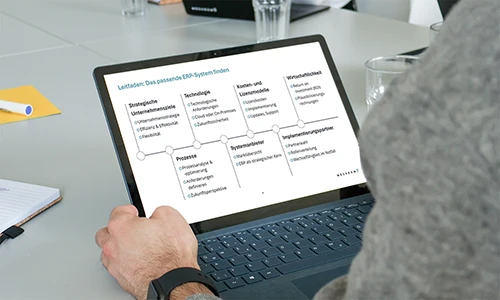
[Guide] Finding the right ERP system
The ERP system forms the digital foundation of a company – connecting processes, data and teams, and creating the basis for efficiency and customer satisfaction. But how do you find the right system? In this guide, you will find valuable tips on what to look out for when choosing an ERP system for a medium-sized business.

Managing energy efficiently: ecoplanet for SMEs
The Munich-based start-up ecoplanet is impressing with innovative energy solutions and rapid growth. Using their software and an energy tariff, they help medium-sized businesses to manage energy costs efficiently, meet certification requirements and achieve their sustainability goals. An exciting partner for the energy future!
Talk to us
Informal chat
Let's talk about your digital transformation in a personal conversation. Easily book a 15-minute chat with founder Fabian Kracht.
Book appointment nowWrite an email
Please do not hesitate to contact us at any time.
We are open to your questions and feedback.