
The AI Maturity Model:
Are you AI-ready?
AI has arrived in the mid-market sector, but is far from where it actually has an impact. Initial experiments have taken place in many companies: a sales employee uses ChatGPT for emails, IT has purchased Copilot licences, and a pilot project is running in quality assurance. These isolated initiatives rarely turn into stable, regular operations that generate real value creation.
55 % of SMEs are in experimental mode. Only 20 % are already using AI productively, whereas 41 % of all companies across all sectors are already actively using AI. The gap is widening and becoming a competitive risk. Those who set the right course now can close this gap.
The central question is: Where do we stand today and what is our next logical step? That is precisely why we developed the mesakumo AI maturity model.

Three stages of development: from initial efficiency to true transformation
Before answering the question „Where do we stand?“, it is worth taking a look at the fundamental logic by which AI generates impact in companies. AI creates value in three consecutive steps:
- Individual productivity
Individual employees work more efficiently with AI tools, for texts, research or documentation. The benefit is individual and scales with the number of active users. - Process automation
Entire workflows are run by AI agents and workflow tools. Decisions are delegated to the AI within defined corridors, with humans only intervening in edge cases. This is where AI begins to have a structural impact on value creation. - Business model transformation
AI is transforming what a company sells. Product, data and service are merging, creating new revenue models and a platform economy.
These three levels form the common thread running through the mesakumo AI maturity model: from initial curiosity to the AI-native organisation.
The Model: Five Stages, Five Dimensions
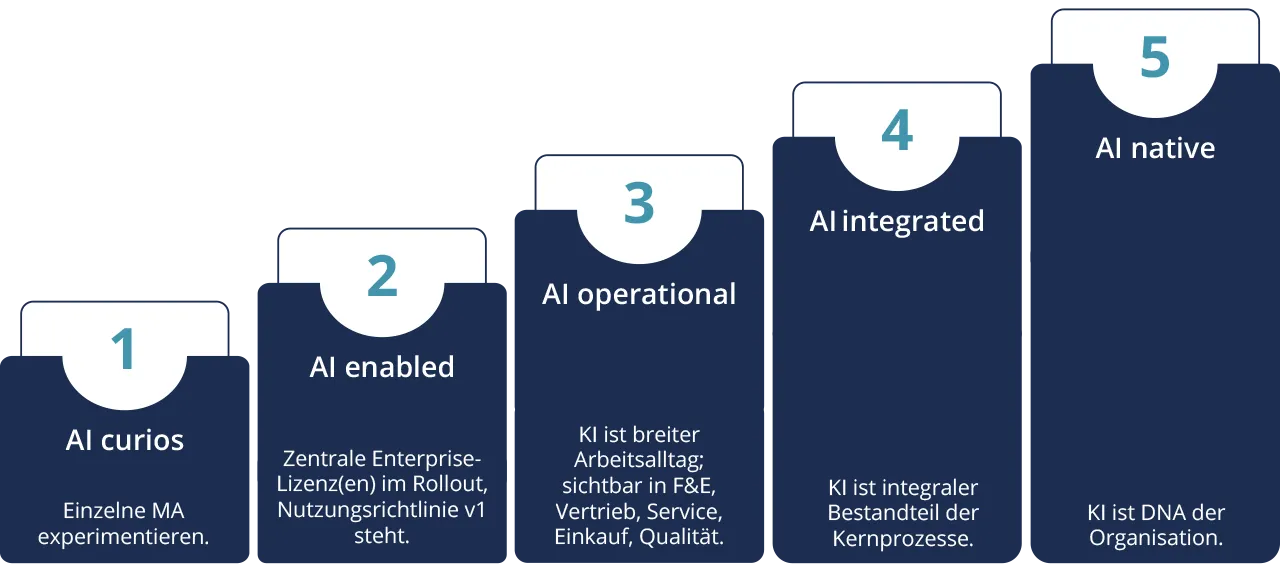
The mesakumo AI maturity model describes the path to becoming an AI-native organisation across five maturity levels: from initial curiosity to the complete integration of AI into processes, products and business model. The maturity level is assessed across five dimensions that are transformed equally by AI:

Strategy & Leadership
From a management team that makes operational decisions to a management team that sets corridors and guardrails within which humans and AI agents steer hand-in-hand.

Data & Technology
From data silos and Excel reports to a real-time data platform powering AI agents.

Value Creation & Use Cases
From product and service sales to an integrated ecosystem offering of products, data and services.

Governance and Ecosystem
From fixed contracts and rigid supply chains to AI agents autonomously negotiating with one another in an open value creation system.

People & Organisation
From fixed departments with managers following routines to human-AI teams that form around tasks and the human-in-the-loop who directs, validates and decides in edge cases.
Businesses rarely develop evenly across these dimensions. An operation may already be at level 3 in technology, but still at level 1 in governance. The model makes such gaps visible – and shows where targeted measures have the greatest leverage.
The five stages at a glance
Level 1
AI Curious: Curiosity without direction
Individual employees are experimenting on their own initiative; AI is a topic of conversation, but not a leadership priority. There is a lack of strategy, accountability, and rules for use. The real danger: pilots are launching without a strategy, shadow AI is running without rules, and budgets are draining away without any proof of impact.
Typical next steps:
- AI readiness check across all 5 dimensions (17 criteria)
- Roll out a centralised AI licence or platform with SSO, channel shadow AI rather than banning it
- Identify 2–3 quick-win use cases with an ROI hypothesis (max. 8 weeks)
Level 2
AI Enabled: Enablement, but no scaling yet
A central enterprise licence has been rolled out, 1 to 3 lighthouse use cases are running productively, AI champions are active in individual departments. Stage 2 is the most dangerous intermediate floor: enough experience to feel competent – too little structure to scale. Around two-thirds of companies get stuck here in pilot mode and fail to make the leap into scaled, company-wide use.⁴
Typical next steps:
- Set up AI Strategy V1 with portfolio logic, moving away from the single project list
- Launch data debt cleanup programme with gates (6–12 months)
- Establish AI-based knowledge management in 1–2 domains
Stage 3
AI Operational: AI becomes part of the working day
AI is visible in sales, service, procurement and quality. Five to ten core processes have a measurable AI component, and a modular platform with an LLM gateway and RAG stack is currently being set up. The biggest hurdle along this path is not the technology, but the organisation: functional silos block AI-driven end-to-end processes. During scaling, the rule of thumb is usually: 70 % change (people, processes, governance), 30 % technology.
Typical next steps:
- Enterprise scaling of the 2–3 most successful use cases
- Agentic AI strategic realignment, piloting first autonomous process chains
- Executive Board decision: maintain efficiency or transformation towards level 4
Level 4
AI Integrated: AI as the core of value creation
AI is an integral part of core processes, with multiple autonomous agents running with a human-in-the-loop. Stage 4 is the turning point: the business model shifts from product to service, from service to ecosystem. An exemplary reference image is provided by the Siemens electronics factory in Erlangen, which in 2026 will become the first fully AI-controlled, adaptive manufacturing plant, with 40 % less material circulation and 70 % less energy consumption. For many SMEs, stage 4 is the realistic and sufficient target image.
Typical next steps:
- Define autonomy guardrails per process, with clear exit triggers
- Organisational transformation: Establishing role profiles including AI partner roles
- Designing AI-native products, from service to platform
Level 5
AI Native: AI as the DNA of the organisation
AI is the organisation's operating system: autonomous agents act within defined corridors, and new use cases emerge in days. Interaction and transaction with suppliers and customers are increasingly taking place on both sides through AI systems. In the German Mittelstand in 2026, Level 5 is the North Star, not widespread reality. Whoever develops structurally in this direction starting from Level 3 has already won.
How we work with the model: From location to roadmap
The model is the tool for a structured situational analysis from which concrete priorities follow. Our approach in practice:

Assessment across all five dimensions
An assessment process (17 criteria) determines the maturity level for each dimension. This almost always reveals imbalances – the technology is running, but the governance is lagging behind; or the management's level of ambition exceeds the actual data situation. Making these gaps visible is the first step.

Derive measures per dimension (roadmap to the next maturity level)
Based on the assessment from step 1, we develop the baseline situation systematically, dimension by dimension: from strategy & leadership, data & technology, and value creation & use cases to governance & ecosystem, as well as people & organisation. This creates a clear path from today's current state to the next level of maturity, rather than a collection of disconnected measures.

Prioritise use cases according to maturity level (value contribution and scalability)
In the next step, we will prioritise use cases so that they match the level of maturity whilst also delivering a clear value contribution. It is crucial that early initiatives deliver benefits quickly and are designed for scaling from the outset.

Make progress measurable
Every productive use case receives a sponsor, a euro target and KPIs based on the 3-tier model: utilisation, quality and impact. This makes AI contributions quantifiable in euros portfolio-wide and protects the budget from the most frequent killer of AI initiatives: a lack of proof of impact.

Do you want to determine your AI maturity level?
Would you like to know where your company stands? Feel free to take our AI maturity check for a quick initial assessment.
Determine AI maturityWhat this means for your business
The first step is an honest assessment of the current situation, taking all five dimensions into account. Anyone who knows their maturity level can prioritise and invest with targeted focus.
Most medium-sized businesses are currently at stage 1–2. This means: the focus should be on an actionable AI strategy, data quality, governance, and capability building. This forms the foundation for every technical investment.
AI offers small and medium-sized enterprises concrete levers in many areas: from individual productivity and process automation to new business models. An example of what this can look like in practice is AI-supported knowledge management, such as the one we use ourselves at mesakumo (More on AI-driven knowledge managementWhich use cases make sense for your business depends directly on your maturity level. That is precisely what we help with.
How AI-ready is your business?
Just 10 short questions, then you'll receive an initial assessment – and, upon request, a 30-minute personal consultation with our AI Practice Lead, Tim Kappel.
Test now with no obligation:
Sources:
¹ kobaltblau / iteratec / Lünendonk & Hossenfelder / VOICE (2025): GenAI – The new reality in the IT organisation 2026+.
https://www.kobaltblau.com/de/insights/studie-genai-die-neue-realitaet-in-der-it-organisation-2026/
² KfW Research (2026): Use of artificial intelligence in SMEs. Focus Economics No. 533.
https://www.kfw.de/PDF/Download-Center/Konzernthemen/Research/PDF-Dokumente-Fokus-Volkswirtschaft/Fokus-2026/Fokus-Nr.-533-Februar-2026-KI-Mittelstand.pdf
³ Bitkom Research (2026): Artificial Intelligence in Germany – Status Quo and Outlook. Study Report 2026.
https://www.bitkom.org/Bitkom/Publikationen/Kuenstliche-Intelligenz-in-Deutschland
⁴ McKinsey & Company (2025): The state of AI in 2025: Agents, innovation, and transformation. McKinsey Global Survey on AI.
https://www.mckinsey.com/capabilities/quantumblack/our-insights/the-state-of-ai
You may also be interested in this

5 years of mesakumo: From the attic to the AI strategy
No technical article this time, but a personal look back from our founders Richard and Fabian. How two consultants with an idea grew into a team of nearly thirty people, what went wrong along the way, and why the product from the drawer is becoming relevant again right now. Fabian takes you through five years of mesakumo.

Growth-oriented IT strategy: A practical report
Many medium-sized enterprises experience it: IT cannot keep pace with growth and becomes a brake instead of a lever. Unclear priorities and a lack of strategy exacerbate the problem. In this recording, Fabian Kracht uses various practical insights to demonstrate how to develop an IT strategy that actively enables growth.

How we establish AI-powered knowledge management
Wissen ist in den meisten Unternehmen verteilt und das kostet täglich Zeit. Mit einer KI-gestützten Wissensplattform machen wir unsere Inhalte strukturiert zugänglich und reduzieren den Aufwand für wiederkehrende Aufgaben spürbar. Lesen Sie, wie auch mittelständische Unternehmen konkret davon profitieren können.
Talk to us
Informal chat
Let's talk about your digital transformation in a personal conversation. Easily book a 15-minute chat with founder Fabian Kracht.
Book appointment nowWrite an email
Please do not hesitate to contact us at any time.
We are open to your questions and feedback.